

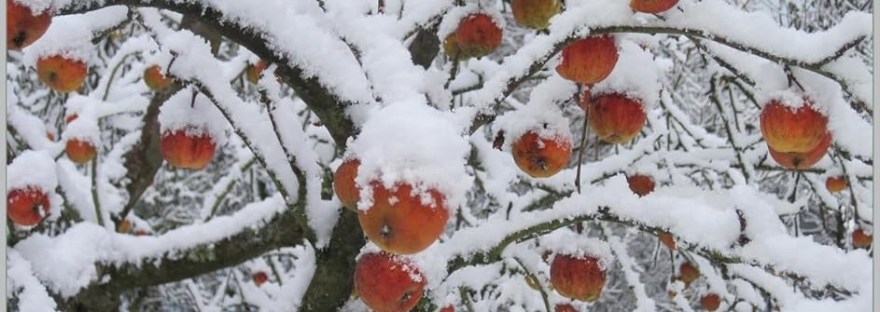
The air was brittle with a cold that threatened to become biting, and endless rows of apple trees cast long shadows under the fading light. Mary Connell looked down at the crumpled brochure in her hands. It seemed that Loughridge Orchard was, at any other time of the year, a shining example of picturesque beauty. She looked back up at the orchard before her, lost in the depths of mid-winter. Loughridge had taken on a dreary face, and the branches of its leafless and fruitless trees clutched at the air like arthritic fingers.
‘Inviting,’ Mary remarked sarcastically.
A hill gently rose from where the driver had dropped her off at the orchard’s edge, scarred by a footpath that led up to the farmhouse. Apple trees towered over the path; their branches curled in such a manner that only the house’s front door remained visible.
‘Jesus wept!’ Mary swore as a chilling breeze whipped her mane of dark brown curls into her face. She readjusted her bobble hat, filled her lungs with cold air, swaddled deeply into her coat, and hauled herself up the path.
From out of the distant farmhouse door, a figure slowly approached. The man was thin and crooked, leaning on his cane. The deep wrinkles of his face stretched out from a pair of eyes as pale and sharp as hoarfrost. This, she knew, must be the orchard’s owner, Sammy Loughridge.
He paused on his descent, choosing to wait for Mary beneath an abnormally large and crooked apple tree. Even in winter, the great tree stood heavy with fruit, broad branches bending under the weight of its bounty. Each gnarled apple’s skin was a patchwork of dull reds streaked with burnished golds and russet browns, as though autumn itself had painted them with its dying breath. Sammy readjusted his flat cap, thin tufts of white hair poking out, then firmly patted the crooked tree’s trunk.
The hairs along Mary’s arms stood on end as she felt his sharp eyes watch her approach.
‘Welcome to Loughridge Orchard,’ he said with a voice like rough whiskey. ‘Hand that over here. I’ll take your suitcase the rest of the way.’
‘Thank you,’ Mary replied. ‘But I’d prefer to bring it up myself, if it’s all the same.’
The old man swiftly redirected his helping hand to brush against her arm. ‘To the house then.’ He smiled and gave a gentle push to guide her ahead of him.
As they reached the end of the rows, the farmhouse came fully into view, no longer hidden by the grasping branches. It was a big house. Ancient grey stone rose from the earth and shaped itself into something that might have once been a church, long estranged from its grace by a change in tenants and thoughtless renovations. The windows seemed to watch Mary with sorrow and regret, as if aware of their own desecration. And just beyond the house, she could see faint light glinting off a large pond…
Interested in reading more? You can find the rest of ‘The Cold Orchard’ on Amazon! Only £0.99 to buy, or free on Kindle Unlimited!
Another short story and another excerpt! Years ago, I published a poem on this blog, ‘Cider Country’. It has always been one of my favourite poems that I’ve posted here, and after recently rereading the poem, I decided to revisit the premise and turn it into a short story. And so ‘Cider Country’ became ‘The Cold Orchard’. Writing it took me a little longer than I would’ve liked, but I’m happy with the finished product, and I hope you all enjoy reading it! – R.K. Lightfoot
At a quiet winter retreat, Mary wishes to do nothing more than write her novel and eat the meals her elderly host cooks for her. But as she comes to learn, the Loughridge Orchard holds more within its boughs than meets the eye. Winter’s cold bite reveals all in this ~6,400-word modern gothic short story that slowly unfolds its tale of guilt, retribution, and the cruel persistence of memory.


 R.K. Lightfoot